

Introducing your child to Shakespeare can feel like offering them a mountain to climb – but at The Playing Space, we believe that it’s a mountain worth climbing, and that every child can find their own path to the summit.
Shakespeare? Ugh.
I remember as a child at school hearing groans around the classroom when our teacher told us we were going to study The Merchant of Venice, now one of my favourite plays. It contains the wonderful monologue from Portia beginning “The quality of mercy is not strain’d” which I used (successfully!) to get into drama school many years ago. I think the fact that it was the first Shakespeare play that I really understood has given it a special place in my heart.
So how did I get from being one of the groaners, to falling in love? The way Shakespeare is taught is so important and I think that one of the biggest mistakes that teachers make is to focus exclusively on the wonderful poetry, the complexity of ideas, the genius of the Bard… and completely ignore the difficulty of the language. I’m going to say it again for the people at the back: SHAKESPEARE IS REALLY, REALLY DIFFICULT! Anyone who says that they can go and watch a completely unfamiliar Shakespeare play and understand every word of it is either lying or a time traveller from the 16th Century.

If you don’t tell a child that Shakespeare is difficult, then when they inevitably fail to understand it they will assume that it is their intelligence that is lacking. This will result in a feeling of alienation and put them off, possibly for life.
If you are a parent reading this: is that you? Does the thought of going to watch a Shakespeare play (let alone perform in one) fill you with a sense of unease, knowing that you’ll be out of your depth? Or are you one of the lucky ones that relish the challenge of a new play or the joy of a familiar one? If you are the former, then I hope you will want your child to be one of the latter. Get them to a drama class!
Anyway, where was I? Ah yes: acknowledging that Shakespeare is difficult is the very FIRST thing that I do. But then I get them to read some. I tell them I want them to read it badly. To stumble through it. I make sure they know that my expectations are low. And then I ask them if they understood it and they say ‘no’ and I reply ‘neither did I the first time I read it’. And then I ask them if there was anything that they understood – maybe just one phrase or idea. What might it have been about? Let’s try it now with Ariel’s Song from The Tempest:
Full fathom five thy father lies;
Of his bones are coral made;
Those are pearls that were his eyes:
Nothing of him that doth fade,
But doth suffer a sea-change
Into something rich and strange.
Sea-nymphs hourly ring his knell:
Ding-dong.
Hark! now I hear them—Ding-dong, bell.
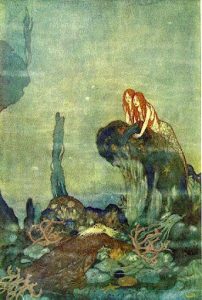
If you are NOT already familiar with this, what did you pick up on the very first reading? Maybe it’s about death? YES! It feels like it’s got something to do with being underwater? YES! The bell sound reminds me of a church bell ringing at a funeral… YES!
Just because we don’t understand every word, it doesn’t mean we don’t have some level of understanding. Shakespeare to me feels like looking at the solution to a cryptic crossword clue – at first you can’t understand it, but when you see it (or someone explains it) there is a feeling of deep satisfaction.
Ariel’s Song is actually included in the current LAMDA Anthology of Verse and Prose at Stage 3, meaning that we would use it for children aged 7 or 8 years old. This is young, and won’t appeal to many children of that age – but I’m glad it’s there as an option.

So, it’s crucial to be honest: Shakespeare’s language is tough, and children will stumble. But at The Playing Space, we frame those hesitations as natural steps on the journey — never as a lack of ability. Last year, one of our 11-year-old students earned a Distinction in their Grade 2 LAMDA Acting exam with a speech from King Henry V. She was the only candidate drawn to its complexity — and loved every moment of the challenge.
For ambitious teens who’ve completed Grade 8 Acting, the LAMDA Level 3 Shakespeare for Performance exam offers the opportunity to select and recontextualise a set speech. In 2024, one of our 16-year-old Level 3 candidates reimagined a speech by Katherine from The Taming of the Shrew as a member of Westboro’ Baptist Church, demonstrating creativity and deep understanding of the text. She also achieved a Distinction and the examiner said: “You are a powerful, determined performer with a strong understanding of Shakespeare’s words.”
Shakespeare that lasts a lifetime
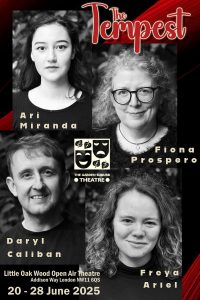
We’re very proud that a graduate of The Playing Space, Freya Carroll, is currently enchanting audiences as Ariel in The Tempest in an open air production by Garden Suburb Theatre this week and next. It’s a wonderful reminder that nurturing a love of Shakespeare in childhood can bloom into roles and adventures years later.
You can book tickets here.
Ready to embark?
If your child is curious about sword fights, star-crossed lovers, or the power of words to move an audience, our expert tutors at The Playing Space create a supportive environment where every child climbs at their own pace. In spite of the challenge, they’ll gain confidence, eloquence, and a lifelong appreciation for the Bard.
If you’d like to sign your child up for classes this Autumn, you can register here. Or click here to find out more about our Summer Holiday clubs!