Parents sign their children up for drama for all sorts of reasons, but the one I hear most often is because they are ‘shy’ and a school teacher has recommended that they try drama classes because they are too quiet in class.
In this article, I’m going to explain why I hate the word ‘shy’ and why it isn’t a weakness anyway!

The Problem With Labels
So, why does a parent describing a child as shy make me wince? It’s because it’s a label that we apply to some children and labels have a funny way of sticking. Children sometimes have feelings but we rarely label the entire child as BEING the feeling. This is Alfie, he’s a bit angry. This is Sarah – she’s a sad child. But we do it all the time with the word shy, often right in front of them, and always with a negative connotation.
I know the effect that this can have on a young brain, because I was this child. It’s genuinely hard to believe because I am and always have been a pretty confident person. But I remember vividly being described as shy when I was growing up. When I was confronted with strangers or people I didn’t know well I would often cling to my mother’s legs, hide my face and refuse to speak. “Sorry, she’s shy,” my mother would say apologetically. But looking back, was this really a flaw or was it actually quite a sensible strategy to use in a world that I had been told could be dangerous? I was cautious at first, watching and listening, working out who felt safe… And then my real personality came out: exuberant, chatty, confident, full of energy!
But because I’d been told I was shy, I started to believe it. And worse than that – I weaponised it! I used it to get out of anything that might make me feel even slightly uncomfortable.
“I can’t speak in assembly – I’m too shy!”
“I can’t go to a new class on my own – I’m too shy!”
A clever child can learn very quickly how to hide behind that word when something feels difficult. And that’s why I always gently encourage parents to avoid using it, especially when their children are within earshot!
And like all labels, ‘shy’ feels fixed. It’s something that is integral to you. Whereas confidence is something that you can build! So this is my preferred choice of words: “so-and-so is building confidence” – it feels like something that is more part of the Growth Mindset universe, where change and learning is possible.
Comfort Zones
In my classes, I talk a lot about comfort zones.
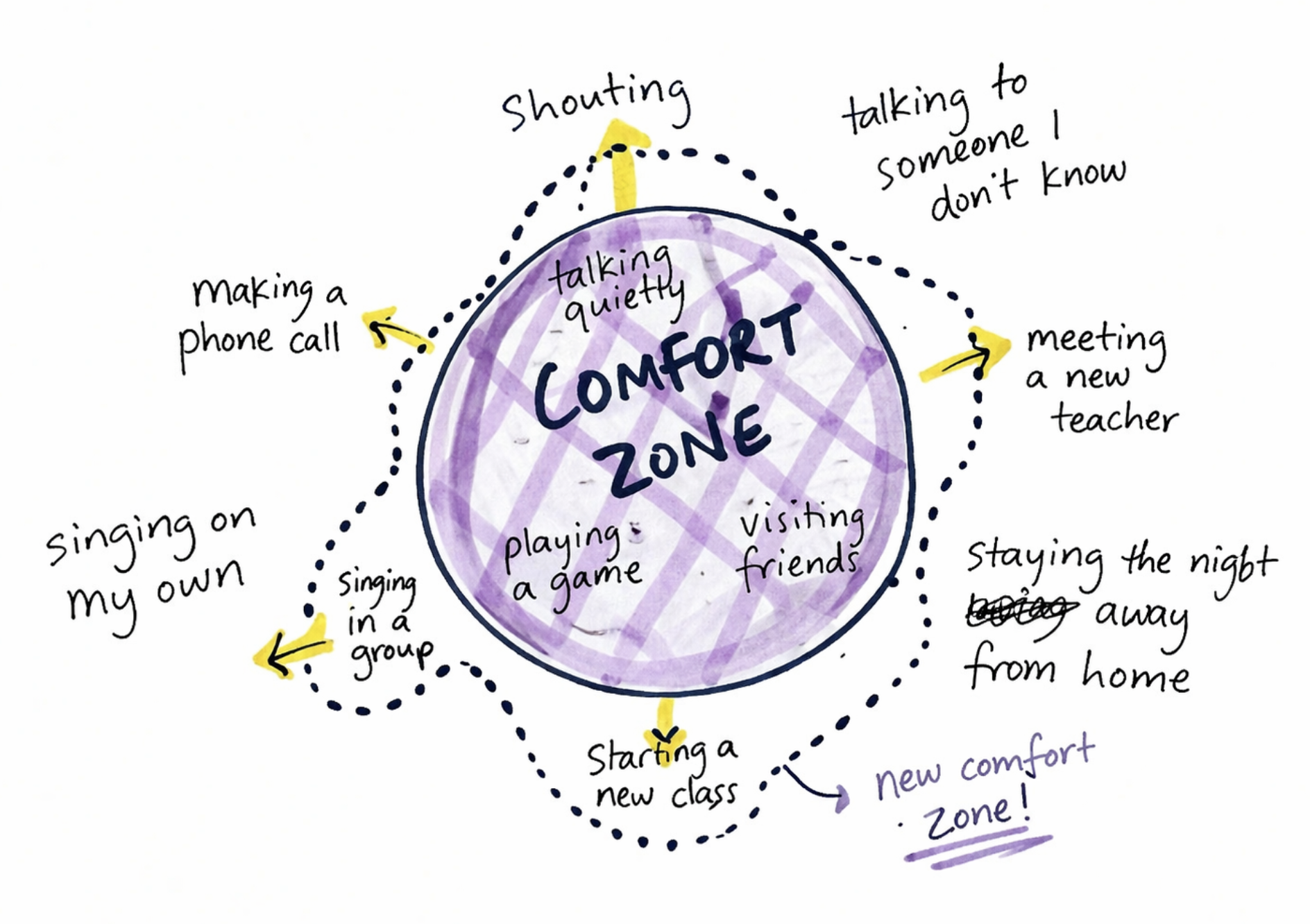
I’ll draw a circle in their notebook and we’ll write inside the circle all the things that they already feel confident doing. Outside the circle we’ll write the things they would rather not do, things that would make them feel uncomfortable – things outside their comfort zone. And then we start to explore the edges, not jump outside it but nudge at the boundaries a little bit. We’ll try something new like speaking in gibberish, or pretending to be a monkey, or saying a poem but missing out all the consonants and only saying the vowel sounds… something that might make them feel a bit awkward or embarrassed (this is a good sign that they are slightly outside their comfort zone) but that they can manage in an environment that they’ve already discovered is safe and non-judgemental.
Then we do it again. And again! Until it doesn’t feel quite so awkward and embarrassing. Until it stops feeling uncomfortable and starts to feel fun! And then guess what? Your comfort zone has expanded.
If your child learns to do this consistently then their world slowly but surely expands. More opportunities are possible. More choices open up.
A Different Perspective
Drama classes aren’t about turning every child into the loudest voice in the room. We really don’t need a world full of over-confident children shouting out answers and performing on demand. But we do want every child to have the confidence to speak when they have something important or interesting to say. The next time you’re tempted to label your child as “shy” ask yourself if they’re shy when they’re at home. The answer is almost certainly, “No, obviously not!” Which means they’re not shy. They just sometimes feel shy, which is completely normal. I sometimes felt shy when I was a child, and I sometimes still feel shy as an adult. But it’s a feeling, not a personality trait.
And even if a particular child feels shy quite often, or it’s a strategy that they over-use, does it have to be a negative? Children who are described as shy are usually observant, thoughtful, imaginative and emotionally aware. These are not weaknesses. They’re actually qualities that make great actors and communicators!
If you would like your child to build confidence, communication and performance skills and have loads of fun in a safe and nurturing environment then click this link to send us their information and ask any questions. We look forward to hearing from you!